Protein on GLP-1 medications matters because you eat less, and part of the weight you lose can be muscle. A 2025 joint advisory from four obesity and nutrition societies lists several targets: 1.2–1.6 g per kg of body weight a day during active weight loss, 1.5 g per kg of lean mass, or a simple 80–120 g a day. Your clinician can help you pick one.
This article is general information, not medical advice. Always follow your prescriber’s instructions and the Medication Guide that came with your medication. If you have kidney disease, ask your doctor before increasing protein.
Key takeaways
- The general adult RDA is 0.8 g of protein per kg of body weight a day, and it is under review.
- The 2025 GLP-1 nutrition advisory lists 1.2–1.6 g/kg, 1.5 g/kg of lean mass, or 80–120 g a day as options.
- In the STEP 1 trial, about 38% of the weight lost on semaglutide was lean mass; in SURMOUNT-1 about 25% on tirzepatide.
- Protein alone isn’t enough: the advisory pairs it with strength training at least 3 times a week.
- Eat protein first at meals and lean on compact foods like eggs, Greek yogurt, fish and cottage cheese.
In this guide
How much protein do you need on a GLP-1?
There’s no single official number yet. The 2025 joint advisory on nutritional priorities to support GLP-1 therapy, published in the American Journal of Clinical Nutrition by the American College of Lifestyle Medicine, American Society for Nutrition, Obesity Medicine Association and The Obesity Society, describes four ways to set a target.
| Approach | Target | Notes from the advisory |
|---|---|---|
| General RDA | 0.8 g/kg/day | The standard adult allowance; “currently undergoing review” |
| Higher, by body weight | 1.2–1.6 g/kg/day | “Proposed during active weight reduction” |
| By lean mass | 1.5 g/kg of lean mass/day | “Considered more accurate,” but needs a body-composition measurement |
| Fixed amount | 80–120 g/day | About 16–24% of calories on a 2,000-calorie diet |
The advisory also sets guardrails. Intake shouldn’t fall below 0.4–0.5 g/kg a day, and prolonged intake at or above 2 g/kg a day should be avoided. The newer 2025–2030 Dietary Guidelines for Americans, summarized by the American Academy of Family Physicians in July 2026, recommend 1.2–1.6 g per kg of body weight for adults in general, though some nutrition researchers have questioned that increase.
Do you lose muscle on a GLP-1?
Some of the weight lost on any calorie-reducing treatment is lean mass, and GLP-1 medications are no exception. In a body-scan substudy of the STEP 1 trial, about 38% of the weight people lost on semaglutide was lean mass, according to the 2025 advisory’s summary. In SURMOUNT-1, about 25% of weight lost on tirzepatide was lean mass.
Lean mass isn’t only muscle: it includes water, organs and bone, so these figures overstate muscle loss. The SURMOUNT-1 analysis, published in Diabetes, Obesity and Metabolism in 2025, found the same 75% fat, 25% lean split on placebo as on tirzepatide. Still, keeping muscle helps strength and daily function, which is why the advisory focuses on protein and resistance training together.
The advisory is direct about it: “increased protein intake alone is likely inadequate” without structured strength training. Its recommendation is strength training at least 3 times a week plus at least 150 minutes of moderate aerobic activity weekly.
Should you base protein on your current or goal weight?
The advisory warns that using actual body weight “can significantly overestimate protein requirements” in people with obesity. That’s why it offers the lean-mass and fixed 80–120 g options. If you don’t know your lean mass, a fixed daily range is the simplest starting point to discuss with your clinician or a registered dietitian.
For a sense of scale, here’s simple arithmetic for the 1.2–1.6 g/kg range at different reference weights. Your clinician may suggest a different reference weight than your current weight.
| Reference weight | 1.2 g/kg | 1.6 g/kg |
|---|---|---|
| 60 kg (132 lb) | 72 g/day | 96 g/day |
| 70 kg (154 lb) | 84 g/day | 112 g/day |
| 80 kg (176 lb) | 96 g/day | 128 g/day |
How do you eat enough protein with no appetite?
Low appetite and stomach side effects are common, especially while the dose is being increased. In the trials behind the Wegovy prescribing information, 44% of people had nausea (vs 16% on placebo). On Zepbound, nausea affected 25–29% depending on dose, vs 8% on placebo.
The advisory’s practical tips work with a smaller appetite rather than against it:
- Eat protein first. Start each meal with the protein portion before you fill up.
- Choose compact foods. Fish, eggs, Greek yogurt, cottage cheese, and nuts or seeds give more protein per bite.
- Shakes and bars are fine. The advisory lists them as acceptable when whole foods are hard to manage.
- Drink enough fluids. Dehydration from vomiting or diarrhea can harm the kidneys, so keep fluids up, and add fiber gradually.
Which foods pack the most protein?
Lean meats, fish, eggs, dairy, tofu and legumes are the most practical sources. Values below are protein per 100 g from the USDA’s FoodData Central database (SR Legacy entries), with a rough serving estimate.
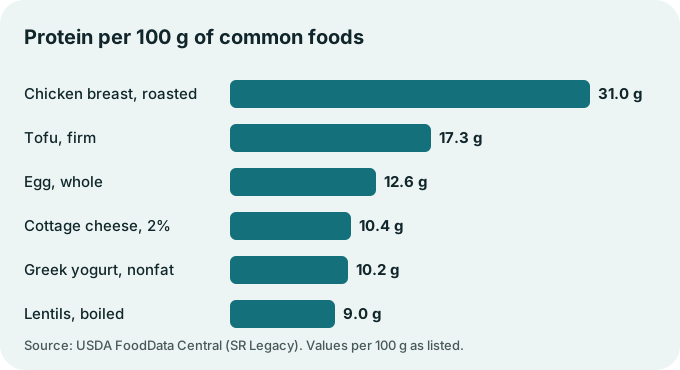
| Food | Protein per 100 g | Rough serving |
|---|---|---|
| Chicken breast, roasted | 31.0 g | ~26 g in 85 g (3 oz) |
| Tofu, firm | 17.3 g | ~15 g in 85 g |
| Egg, whole | 12.6 g | ~6 g in one large egg (50 g) |
| Cottage cheese, 2% | 10.4 g | ~12 g in ½ cup (113 g) |
| Greek yogurt, plain nonfat | 10.2 g | ~17 g in a 170 g cup |
| Lentils, boiled | 9.0 g | ~9 g in ½ cup (99 g) |
A day built from these adds up fast: a Greek yogurt at breakfast, eggs at lunch, and a palm-sized chicken portion at dinner come to roughly 60 g before snacks.
Is high protein safe for your kidneys?
For people with chronic kidney disease, more protein isn’t automatically better. The National Institute of Diabetes and Digestive and Kidney Diseases notes that “some people with CKD may need to consume moderate amounts of protein so waste doesn’t build up in the blood,” in its guide to eating with CKD.
The GLP-1 advisory adds that people at risk of kidney problems should have their kidney function monitored, partly because dehydration from stomach side effects can cause acute kidney injury. If you have kidney disease or diabetes-related kidney changes, set your protein target with your doctor or a renal dietitian.
Tracking protein without counting everything
You don’t need to log every calorie to hit a protein goal. Many people track just one number a day: grams of protein. A short list of go-to foods, like the table above, makes that quick.
Wanewell (our app, coming soon) shows protein, water and fiber as three daily rings next to your shot schedule, so you can see at a glance whether today is on track. You set the target, ideally with your clinician; Wanewell doesn’t prescribe one.
Where Wanewell falls short. It isn’t available yet, and it doesn’t replace a dietitian. It can’t measure lean mass, so if you want a lean-mass-based target, you’ll need a body-composition test from your clinic.
Frequently asked questions
How much protein should I eat a day on Ozempic or Wegovy?
The 2025 joint advisory doesn’t give one number. It lists 1.2–1.6 g per kg of body weight during active weight loss, 1.5 g per kg of lean mass, or a fixed 80–120 g a day as options. Ask your prescriber or a dietitian which fits you.
Is the protein target different on Zepbound or Mounjaro?
The advisory’s guidance applies to GLP-1-based medications for obesity in general, including tirzepatide. The same options apply: a body-weight range, a lean-mass target or 80–120 g a day, paired with regular strength training.
Are protein shakes OK on a GLP-1?
Yes. The advisory lists protein shakes and bars as acceptable options, especially when appetite is low or whole foods are hard to finish. Check labels for added sugar, and keep up your fluids and fiber.
Can you eat too much protein?
The advisory says prolonged intake at or above 2 g per kg of body weight a day should be avoided. People with chronic kidney disease may need moderate protein, so they should set a target with their doctor.
Does strength training matter if I eat enough protein?
Yes. The advisory states that more protein alone is likely inadequate to protect muscle without structured strength training. It recommends strength training at least three times a week plus at least 150 minutes of moderate aerobic activity.
Sources
- Mozaffarian D, et al. Nutritional priorities to support GLP-1 therapy for obesity: a joint Advisory (ACLM, ASN, OMA, TOS). American Journal of Clinical Nutrition. 2025;122:344–367. Published online May 30, 2025.
- Look M, et al. Body composition changes during weight reduction with tirzepatide in the SURMOUNT-1 study. Diabetes, Obesity and Metabolism. 2025;27(5):2720–2729.
- Wilding JPH, et al. Once-weekly semaglutide in adults with overweight or obesity (STEP 1). New England Journal of Medicine. 2021;384:989–1002.
- Novo Nordisk, Wegovy Prescribing Information, revised 08/2025 (FDA).
- Eli Lilly, Zepbound Prescribing Information, revised 2026.
- American Academy of Family Physicians, Practice Guidelines: Dietary Guidelines for Americans 2025–2030. American Family Physician, July 2026.
- NIDDK, Healthy Eating for Adults with Chronic Kidney Disease, reviewed January 2025.
- USDA Agricultural Research Service, FoodData Central (SR Legacy: FDC IDs 171477, 172475, 171287, 172182, 170894, 172421).

The Wanewell team builds Wanewell, a GLP-1 shot tracker. We write our guides from the official prescribing information and peer-reviewed research, and link every source so you can check it. Spotted an error? Tell us.