GLP-1 injection site rotation means using a different spot for each weekly shot. The FDA labels for semaglutide (Ozempic, Wegovy) and tirzepatide (Mounjaro, Zepbound) all allow three areas: the abdomen, the thigh and the upper arm. Every label says to rotate sites with each dose. You can stay in the same area, as long as the exact spot changes each week.
This article is general information, not medical advice. Always follow your prescriber’s instructions and the Medication Guide and Instructions for Use that came with your medication.
Key takeaways
- All four medications can be injected under the skin of the abdomen, thigh or upper arm.
- The labels say to rotate injection sites with each dose. A new spot in the same area is fine.
- Novo Nordisk’s instructions (Ozempic, Wegovy) say to stay at least 2 inches from your belly button.
- Lilly’s instructions (Mounjaro, Zepbound) say the back of the upper arm should be injected by another person.
- The labels report similar drug exposure across the three areas, so no site is “best” for results.
In this guide
Where can you inject a GLP-1?
You can inject semaglutide and tirzepatide pens into the fatty layer under the skin in three areas: the stomach (abdomen), the front of the thigh, and the upper arm. That list comes from the prescribing information for Ozempic and Zepbound, and it’s the same for Wegovy and Mounjaro.
The details differ a little between the two manufacturers, which most guides skip:
| Medication | Allowed areas | Extra instruction |
|---|---|---|
| Ozempic (semaglutide) | Abdomen, thigh, upper arm | Abdomen at least 2 inches from the belly button; back of the upper arm only with help from someone else (prefilled syringe instructions) |
| Wegovy (semaglutide) | Abdomen, thigh, upper arm | Lower stomach, keeping 2 inches away from the belly button (pen instructions) |
| Mounjaro (tirzepatide) | Abdomen, thigh, back of upper arm | The upper arm should be injected by another person |
| Zepbound (tirzepatide) | Abdomen, thigh, back of upper arm | The upper arm should be injected by another person |
The 2-inch belly-button rule appears in Novo Nordisk’s documents. Lilly’s Zepbound pen instructions don’t give a distance. If your pen came with different instructions, follow the leaflet in your box.
What does each label say about rotation?
All four labels tell you to change your injection spot every time. The Wegovy, Mounjaro and Zepbound prescribing information use the same wording: “Rotate injection sites with each dose.” The Ozempic label adds that you should “use a different injection site each week when injecting in the same body region.”
Lilly’s pen instructions spell out what that means in practice: “Change (rotate) your injection site each week. You may use the same area of your body but be sure to choose a different injection site in that area.” So you don’t have to switch from your stomach to your thigh every week. You do have to move off last week’s spot.
If you also use insulin
The Ozempic and Mounjaro labels say it’s acceptable to inject the GLP-1 and insulin in the same body region, but the injections should not be next to each other. They should never be mixed in one injection.
Why does rotating injection sites matter?
Rotating sites gives each patch of skin time to recover and lowers the chance of a firm, lumpy area forming under the skin, called lipohypertrophy. In a 2013 study of 430 people injecting insulin, 64% had lipohypertrophy, but only 5% of those who rotated correctly did.
That research is in insulin users, not GLP-1 users. We couldn’t find GLP-1-specific data on lumps from repeated injections. It’s still the best evidence on why spreading injections out matters for anything injected under the skin, and injection guidance from diabetes educators, such as the 2016 injection technique recommendations in Mayo Clinic Proceedings, recommends rotation for the same reason.
A simple weekly rotation plan
The easiest plan is a fixed 6-week cycle across six zones, so you never have to remember where you went last. Each week, pick a spot in the zone that’s different from the last time you used it. After week 6, start again at week 1.
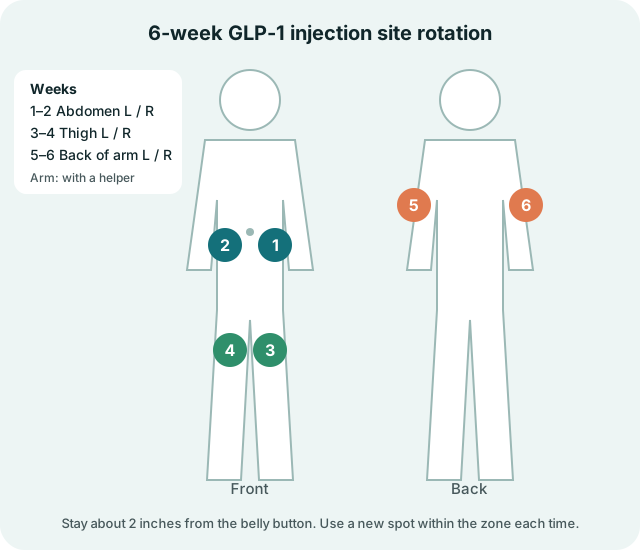
| Week | Zone | Notes |
|---|---|---|
| 1 | Abdomen, left side | Stay 2 inches from the belly button (Novo instructions) |
| 2 | Abdomen, right side | Same distance rule |
| 3 | Left thigh, front | Middle of the front of the thigh is easiest to reach |
| 4 | Right thigh, front | Use a different spot than in week 3’s mirror image |
| 5 | Back of left upper arm | Have someone else inject (Lilly; Ozempic syringe) |
| 6 | Back of right upper arm | Or swap weeks 5–6 for the abdomen if no one can help |
If you prefer one area, that’s allowed too. Imagine the area as a grid of spots a few finger-widths apart, and move to the next spot each week. If a spot is sore or irritated, skip it and ask your pharmacist or prescriber about it.
Is one injection site better than another?
No site is better for results. The prescribing information reports that drug exposure was similar whether semaglutide or tirzepatide was injected into the abdomen, thigh or upper arm. Pages that claim the stomach “absorbs best” or gives more weight loss aren’t backed by the labels. Choose the area that’s comfortable and easy for you to reach.
Some people find the thigh less sensitive, and others prefer the abdomen because it’s easy to see. Both are fine. What matters more is injecting on schedule and changing the spot each time.
What if you get redness or a lump at the injection site?
Mild injection-site reactions such as redness or discomfort can happen, and they’re listed in the labels. In clinical trials they were reported by 0.2% of Ozempic users, 1.4% of Wegovy users (vs 1% on placebo), and 6–8% of people on Zepbound depending on the dose, compared with 2% on placebo.
| Medication | Injection-site reactions in trials | Placebo |
|---|---|---|
| Ozempic | 0.2% | – |
| Wegovy | 1.4% | 1% |
| Mounjaro | 3.2% | 0.4% |
| Zepbound | 6% (5 mg), 8% (10 mg and 15 mg) | 2% |
Rates come from each medication’s prescribing information (labels revised 2026). If a reaction is spreading, very painful, or comes with swelling of your face, lips or throat, or trouble breathing, get medical help right away. For anything that worries you, call your prescriber or pharmacist.
How to keep track without a notebook
The hard part of rotation isn’t the rule. It’s remembering where you went seven days ago. A phone note or a calendar entry works: write the zone and side each time you inject.
Wanewell (our app, coming soon) does this automatically. When you log a shot, a body map shows where you injected last and suggests the next zone in your rotation. Your dose history stays in the same place, so you can show it to your doctor. Wanewell doesn’t tell you what dose to take; you enter the dose your prescriber gave you.
Where Wanewell falls short. It isn’t available yet, and a site suggestion is only a reminder. It can’t see your skin, so always skip any spot that’s sore, bruised or hard, even if it’s next in the rotation.
Frequently asked questions
Can I inject in the same spot every week?
No. Every label says to rotate your injection site with each dose. You can keep using the same area, such as your abdomen, but choose a different spot within it each week so the skin underneath has time to recover.
How far from the belly button should I inject?
Novo Nordisk’s instructions for Ozempic and Wegovy say at least 2 inches (5 cm) from your belly button. Lilly’s Mounjaro and Zepbound pen instructions don’t state a distance, but staying a couple of inches away is a simple habit that works for every pen.
Does the injection site affect weight loss?
The prescribing information reports similar drug exposure across the abdomen, thigh and upper arm. There’s no label evidence that one site leads to more weight loss. Pick the site you can reach comfortably and that you’ll rotate consistently.
Can I inject a GLP-1 into my buttocks?
The buttocks are not a listed injection site in the labels for Ozempic, Wegovy, Mounjaro or Zepbound. Stick to the abdomen, thigh or upper arm unless your prescriber tells you otherwise.
Can I inject my own upper arm?
Lilly’s Mounjaro and Zepbound instructions say another person should inject the back of your upper arm, and Ozempic’s prefilled syringe instructions say the same. If no one can help, use your abdomen or thighs instead.
Sources
- Novo Nordisk, Ozempic (semaglutide) Prescribing Information and Medication Guide, revised 05/2026.
- Novo Nordisk, Wegovy (semaglutide) Prescribing Information, revised 06/2026.
- Eli Lilly, Mounjaro (tirzepatide) Prescribing Information, revised 11/2026.
- Eli Lilly, Zepbound (tirzepatide) Prescribing Information, revised 11/2026.
- Eli Lilly, Zepbound single-dose pen Instructions for Use, April 2026.
- Eli Lilly, Mounjaro Instructions for Use, April 2026.
- Blanco M, et al. Prevalence and risk factors of lipohypertrophy in insulin-injecting patients with diabetes. Diabetes & Metabolism. 2013;39(5):445–453.
- Frid AH, et al. New Insulin Delivery Recommendations. Mayo Clinic Proceedings. 2016;91(9):1231–1255.
The Wanewell team builds Wanewell, a GLP-1 shot tracker. We write our guides from the official prescribing information and peer-reviewed research, and link every source so you can check it. Spotted an error? Tell us.